
Sudoor Manthan- IIRS Science Portal
Long-term observational datasets are essential for understanding the magnitude and frequency of past extreme events over extended timescales. In mountain regions where instrumental records are limited, tree rings provide a valuable natural archive of environmental and geomorphic changes. Tree rings are formed by the vascular cambium, a thin layer of dividing cells between the wood (xylem) and bark (phloem). At the start of each growing season, it produces new xylem inward and phloem outward, forming one annual ring. Variations in temperature, rainfall, and other environmental conditions influence cell size, density, and structure, allowing tree rings to preserve evidence of past disturbances such as floods, landslides, and debris flows.
Dendrogeomorphic Signals of Past Extreme Events in Bhilangana Valley
A field-based investigation was carried out in the Bhilangana Valley in Tehri Garhwal, Uttarakhand, particularly along the Ghuttu–Gangi corridor, to identify dendrogeomorphic signals of past extreme events. The region shows a clear altitudinal vegetation gradient, ranging from Pinus roxburghii-dominated subtropical forests on lower slopes to mixed oak forests of Quercus leucotrichophora and Quercus semecarpifolia, and further to higher elevations dominated by Rhododendron arboreum, Juglans regia, and high-altitude bamboo. The field observations revealed clear evidence of past disturbances preserved in trees. These include scar marks, exposed roots above the ground surface, and tilted tree stems. Such features are commonly linked to debris flows, flash flood, landslides and avalanche. When trees are suddenly impacted or buried by moving material, their growth is disturbed. In response, they often develop reaction wood to regain stability and continue upright growth.
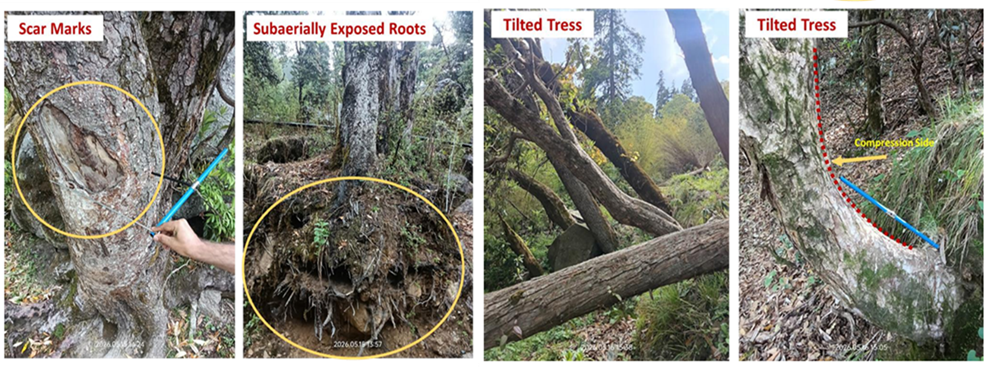
Figure-1: Field photographs showing dendrogeomorphic indicators, including scar marks and sub-aerially exposed roots at Rehchak, and tilted trees observed at Gangi.
Field Sampling and Interpretation of Tree-Ring Cores
Tree-ring samples were collected using an increment borer, a simple hand-operated tool used to extract narrow cylindrical cores from living trees with minimal damage. Cores were taken at breast height (DBH), extending from bark to pith, to capture the full record of radial growth. In disturbed trees, samples were collected near visible wounds where callus tissue and resin ducts had formed, as these features help identify the timing of injury. Reference samples were also collected from nearby undisturbed trees to establish normal growth patterns and separate climatic signals from disturbance-related changes. Tree cores from disturbed zones commonly show abrupt changes in ring width, variations in density, and darkened or irregular bands associated with geomorphic impacts. In contrast, reference trees from undisturbed sites generally display uniform, concentric growth rings with few structural irregularities.
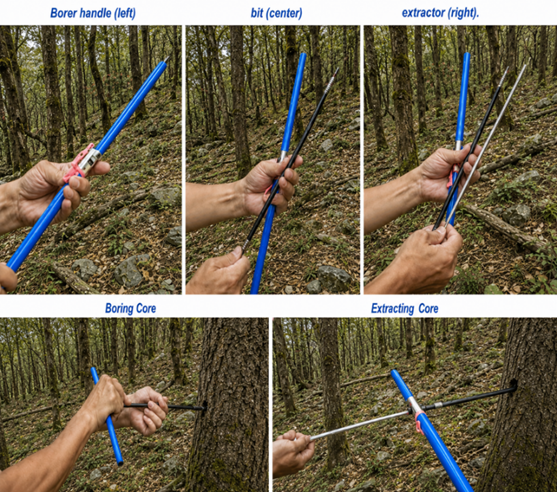
Figure-3: Field photographs of tree-ring samples collection using an increment borer.
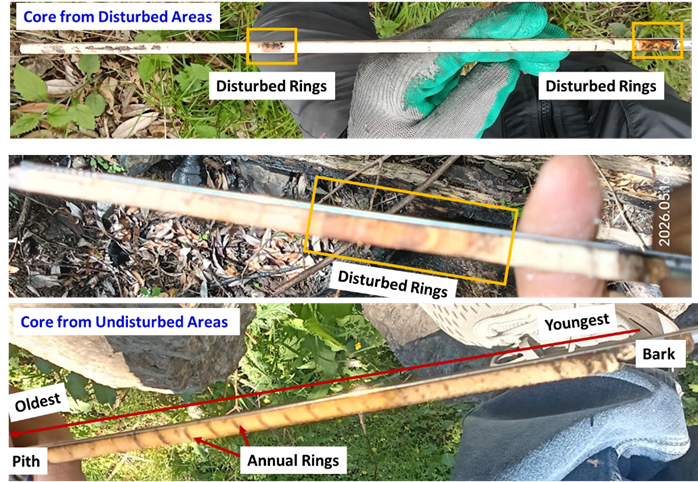
Figure-2: Field photographs of tree ring cores extracted from the disturbed and undisturbed zones.
Scope of Dendrochronology in Himalayan Region
The limited availability of long-term observational records in the mountainous catchments highlights the significant potential of dendrochronological studies for reconstructing past environmental and hydrological events in Himalayan region (Shekhar & Bhattacharya, 2015). Tree rings, integration with remote sensing, can improve the detection and spatial understanding of environmental processes (Upadhyay et. al., 2021).
Acknowledgement:
The authors sincerely thank the Director, Indian Institute of Remote Sensing, for valuable insights and encouragement. They also express gratitude to Dr. Mayank Shekhar and Dr. Sheikh Nawaz Ali and Ms. Arushi Kumar of the Birbal Sahni Institute of Palaeosciences for their guidance and support during the field visit to the study area.
Bibliography
Shekhar, M., & Bhattacharyya, A. (2015). Reconstruction of January–April discharge of Zemu
Chuu–A first stage of Teesta River North Sikkim Eastern Himalaya based on tree-ring data of
fir. Journal of Hydrology: Regional Studies, 4, 776-786.
Upadhyay, K. K., Shah, S. K., Roy, A., & Tripathi, S. K. (2021). Dendroclimatology of teak indicates prevailing climatic conditions of tropical moist forests in India. Ecological Indicators, 129, 107888.