
Sudoor Manthan- IIRS Science Portal
Rice is the staple food for nearly two-thirds of India’s population, particularly in eastern, northeastern and southern India, and is also consumed occasionally in the northern and central parts of the country. Indian Council of Agricultural Research (ICAR) is executing a 5-year pilot project on crop diversification (2023–2028) under the National Food Security and Nutrition Mission (NFSNM) in order to help Haryana and Punjab move away from paddy cultivation at least in 10-15% of the area with Government incentives and support. Total paddy acreage in Punjab stands at 30.58 lac Ha for the current Kharif season, showing a decrease (2 lakh hectares) during the same period last year. Non-basmati paddy covers 25.88 lakh hectares, while the remaining area is under basmati cultivation. The benefit of NFSNM are two-fold, reducing the groundwater consumption and nutritional security through pulses.
The state uses a phased / staggered transplanting sequence—starting in early June—dividing regions to manage water and power needs and conserve groundwater after the Water Act of 2009. There is focus Direct Seeding of Rice (DSR) with smooth seedbed preparation and transplantation with financial incentives to conserve the ground water table which is depleting at an alarming rate. The sequence of the transplantation date is effectively picked up by NASA-ISRO Synthetic Aperture Radar (NISAR) S-band (3.2 GHz, 9.4 cm wavelength) data – in systematic coverage of 240 km swath at 10 m resolution achieving the high resolution at larger swath utilizing the SWEEPSAR technique first time globally.
Three date SAR data temporal FCC is shown in Fig.2. The paddy fields corresponding to the bright cyan- blue colour in the FCC are the earliest transplanted rice during 2nd week of June (10-15th June) also picked up in the frequency graph, followed by end June – dark blue (20-25 June), then 2nd week of July in magenta (10-15th July)/and finally late transplantation by 3rd week of July seen as yellow isolated fields in the right side and bottom part.
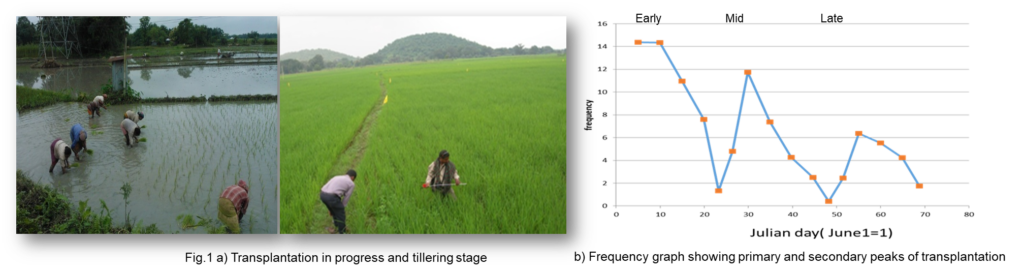
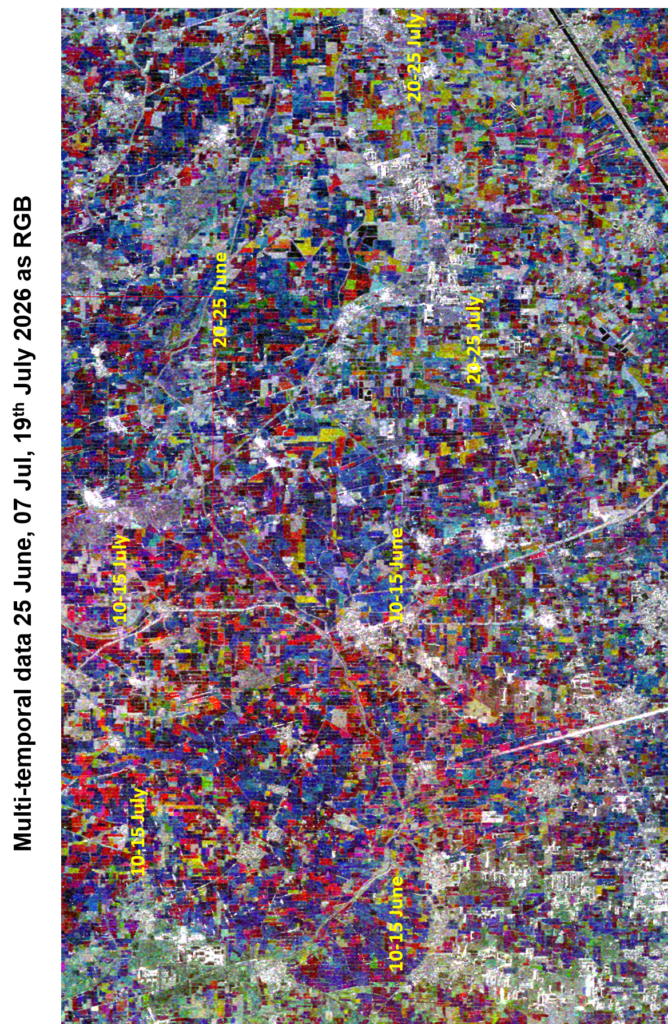
Fig.2 : 03- Dates FCC showing primary, secondary and late transplantation at field level
Bibliography:
Initial results using RISAT-1 C-band SAR data. Manab Chakraborty, Sushma Panigrahy, A. S. Rajawat, Raj Kumar,T. V. R. Murthy, Dipanwita Haldar, Abhisek Chakraborty, Tanumi Kumar, Sneha Rode, Hrishikesh Kumar, Manik Mahapatra and Sanchayita Kundu. Current Science Vol. 104, No.4, Feb, 2013.
Characterization of monsoon and summer season paddy transplantation date in India using RISAT-1 Synthetic Aperture Radar. Dipanwita Haldar and Manab Chakraborty. Geocarto International, July 2019. DOI: 10.1080/10106049.2019.1641559.
Bimal K. Bhattacharya, V. M. Chowdary , Ayan Das , Mukesh Kumar , Srikanth Poloju , Mamta Kumari , Abhishek Chakraborty , Dipanwita Haldar and Saroj Maity. Inventory and mapping of kharif crops using machine learning with EOS-04 time-series SAR data. Current Science. SPECIAL SECTION: OBSERVATIONS USING EOS-04, May 2024.