
Sudoor Manthan- IIRS Science Portal
Sal forests cover 11 million hectares in the Indian subcontinent. They are important for the environment and the economy because they support biodiversity and provide a range ecological services including livelihoods of indigenous people. These forests face a major threat from an insect called the Sal Heartwood Borer, or “Hoplo”. When these beetles multiply quickly, they kill thousands of trees. Because sal forests grow in rugged, remote regions, crew on the ground cannot easily see how far the damage has spread. To find the extent of damage, researchers at the IIRS used satellite technology to study the beetle affected trees from space.
The sal heart wood boring beetles emerge from tree bark during the monsoon season between June and September to lay their eggs (Figure 1). When the larvae hatch, they spend 9 to 10 months tunneling deep into the wood. This weakens the tree and stops it from getting nutrients. In the beginning, called the “green attack stage,” the tree looks completely healthy from the outside while being eaten from the inside (Figure 2). Later on, the leaves turn rust-red and eventually fall off, leaving a bare grey tree. These sal heart wood boring beetles have caused massive damage in the past. For example, they killed about 7 million trees in Mandla and Kanha between 1923 and 1928, nearly 3 million trees in Palamau in 1961, and over 80,000 trees in the Dehradun Valley between 1916 and 1924.
To find these damaged trees, the researchers used Maxar Technologies’ WorldView-2 satellite, which can capture clear details down to 1.64 meters using visible and NIR channels to see changes in the trees. When a Sal tree is dying from a borer attack, its internal systems fail and its leaves change color from green to red or orange. Researcher used a Random Forest classifier to recognize these specific color changes. The satellite could not spot the early green stage, but it identified the red stage with 84.2% accuracy and the dead grey stage with 85.7% accuracy. The study found that taking satellite images in November offers the best clarity to spot these dying trees before the beetles move to healthy ones.
The researchers computed tree mortality across a 351 square kilometer area between 2015 to 2022 (Figure 3). The nature of damage was clustered in specific pockets where Sal trees grow close together. The worst-hit areas were the Doon Valley, Jim Corbett National Park, and the Nandhaur Wildlife Sanctuary. In the Dehradun region, forest areas like Timli, Asarodi, Jhajra, and Raipur lost many trees, with the Timli area losing trees every single year of the study. Other affected areas included Kalesar National Park in Haryana, and parts of the forest near the India-Nepal border. By comparing the data, researcher found that the beetles attack the most robust, dense stands of Sal trees that grow in areas with high rainfall and deep soil. Sal forests with a mix of different tree species and sizes were much safer.
Between 2015 and 2022, the sal forest lost an average of 1,084 trees each year. Over the whole study period, the study computed 6,501 dead trees, which equals 8,057 tonnes of lost biomass and a loss of about ₹71 crore in timber value. Furthermore, ground checks showed that the satellite can only see 10% to 15% of the total damage, meaning many more trees are secretly infested and could trigger a larger outbreak.
This study shows that traditional tracking methods are no longer enough. The researchers recommend using satellites regularly to map high-risk areas so forest managers can intervene early. To stop the beetles, foresters can use sanitation logging, which means cutting down and removing the red and grey trees to kill the insect larvae inside before they grow into *** beetles. They can also use the “trap-tree method,” where they cut down less valuable Sal trees and beat the wood to release a scent that lures the beetles into traps. For long-term protection, forest managers need to stop planting only Sal trees and instead encourage mixed forests with many different types of plants.
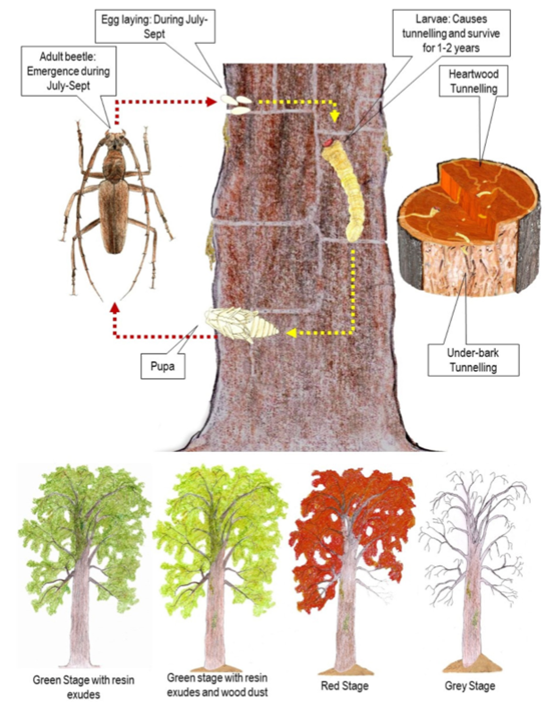
Figure 1– Life cycle of Sal heartwood boring beetle and changes in morphology and physiology of infested sal tree.
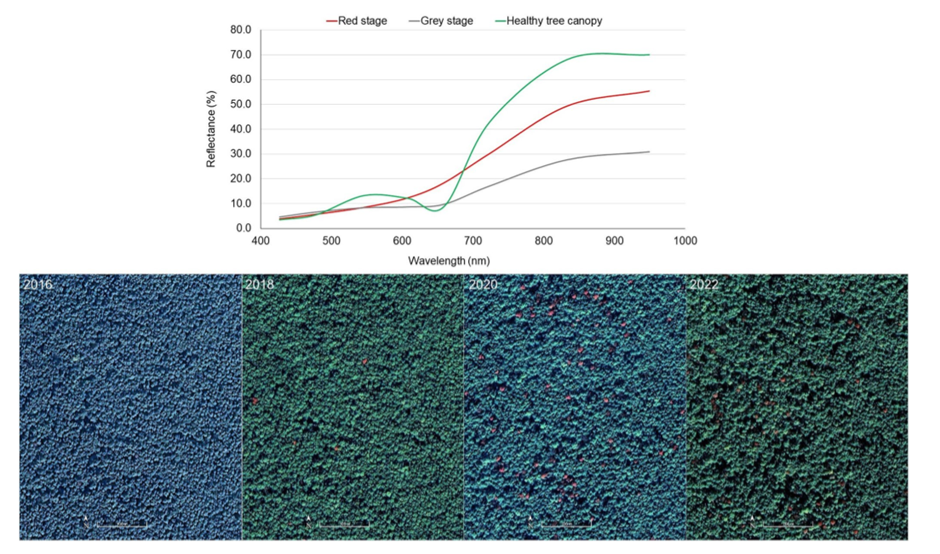
Figure 2– Spectral signature of different stages of infestation and visual appearance of the infestation and forest structural changes in multi-temporal WV-2 satellite images
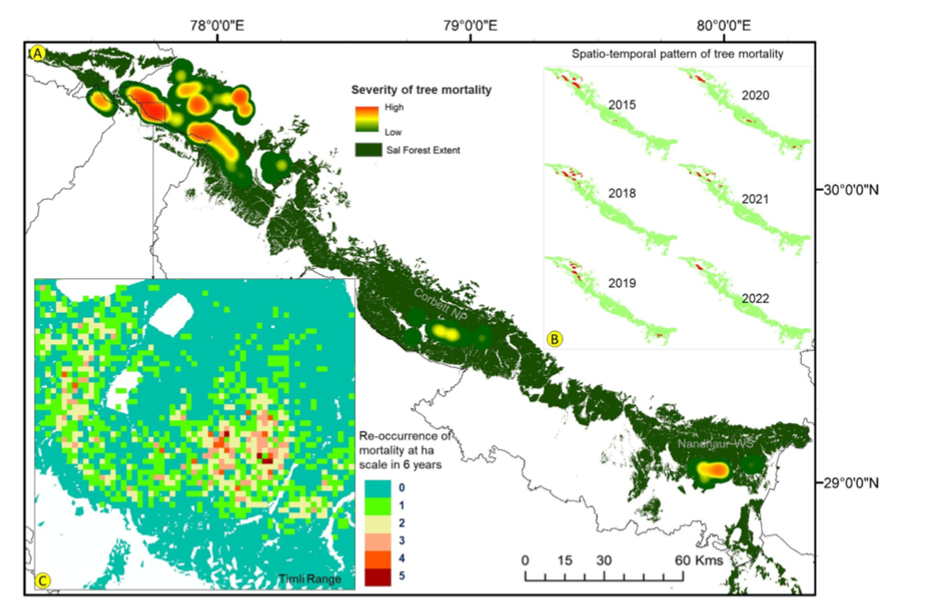
Figure 3- (A) Tree mortality hotspots across the North West Himalayan foothills, (B) Spatio-temporal pattern of tree mortality in different study years and (C) spatio-temporal pattern of tree mortality in most severely affected Timli forest range in Dehradun forest division.
Source: Padalia, H., Rai, I. D., & Singh, R. P. (2026). “Remote Sensing of Sal Heartwood Borer Infestation, Spatio-Temporal Dynamics and Impact on Biomass Stock of Sal Forests of North-West Himalaya.” Journal of the Indian Society of Remote Sensing. DOI: 10.1007/s12524-026-02525-8.