 Charu Singh |
October 22, 2026 |
51 Views |
1 Comments
|

Dust storms originating in arid or semi-arid regions play a critical role in modulating regional climate, surface reaching solar radiation, atmospheric chemistry, and marine ecosystems through long-range transboundary transport. When mineral dust trails traverse continental landmasses and oceanic basins, they alter atmospheric radiative balances, degrade air quality and deposit essential nutrients onto open ocean, driving bio-geochemical feedback loops. Understanding these multi-dimensional impacts requires synergistic use of multiplatform data sets such as satellite, in-situ observations, reanalysis data sets coupled with advanced numerical modeling. Severe dust storms originated from the middle East (mid-March 2012) and Thar region (June, 2018) respectively were comprehensively examined to understand the impact of dust on the surrounding environment. Degradation in the air quality was noted along the passage of the dust event across the region. The former one was originated from the West Asia (a notable dust source region) that traversed the Arabian Sea to affect the Indian subcontinent and the second one was emanated from the Thar Desert of India and was responsible for severely degraded air quality in Northern Part of India. The basic difference in these two events was the difference in the seasons. The West Asian event occurred during pre-monsoon season, whereas the later one was initiated when the Indian summer monsoon was in its initial phase of the progression. The source regions in both the cases were hyper-arid regions, where strong surface winds (higher than the threshold wind speed which is sufficient enough for erosion of the dust particle from the surface) and synoptic forcing pumped huge amount of mineral dust particles high into the atmosphere. In the first case, the dense plume of dust particles travelled thousands of kilometers towards east, sweeping across the Arabian sea region, entered in the Indian region and severely degraded ambient air quality, altering local thermodynamics, and modified oceanic surface conditions along the long range trajectory. Likewise, in the second case, huge amount of dust particles emanated from the Thar region was transported towards northern part of India and modified/altered the ground reaching solar radiation. Noticeable enhancement in coarse dust particles in the ambient air was noted. Satellite based LIDAR observations showed accumulation of dust particle up to 4-5 km of height from the surface in both the cases.
In the former dust storm case, reduction in the ground reaching solar radiation due to the enhanced dust particles resulted in the alteration of atmospheric conditions and led to a substantial drop in the sea surface temperature (SST) over the Arabian Sea. Furthermore, the deposition of nutrient- rich mineral dust triggered a biological response in the Arabian sea and an incremental growth of chlorophyll-a concentration is noted after 4 days of the dust particles enhancement over the Arabian Sea. This helps us to understand the sequence of the positive feedback mechanism between atmospheric dust deposition and oceanic phytoplankton growth.
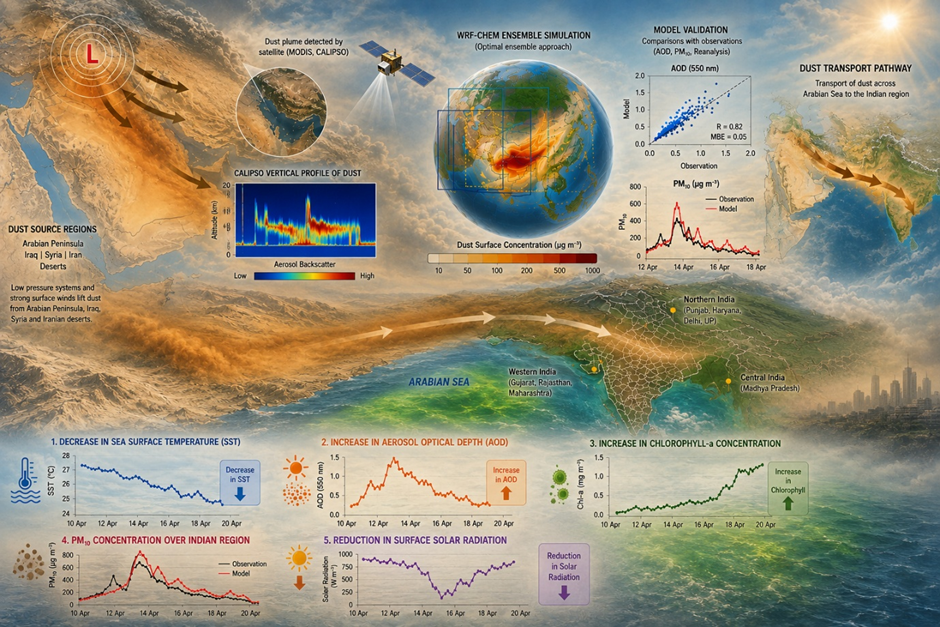
Figure: Indicative representation of impact of dust on surrounding environment.
In case of severe dust storm originated from the Thar region, a remarkable reduction of about ~100–150 W/m2 in the ground reaching solar radiation was noted due to the increased dust particles during dust storm. This substantial reduction in the ground reaching solar radiation further resulted in the reduction of the surface temperature of about 2℃. Concurrently, atmospheric profile vagaries exhibit marked local temperature enhancements alongside sharp relative humidity reductions in the mid-troposphere (800 to 600 hPa).
Thus, dust particles are considered very important regional contributors in modulating physical and thermodynamical conditions in the atmosphere as well as initiating biological response in the oceanic region.
References
- Budakoti, S., Singh, C. and Choudhury, A (2023). Transport of a severe dust storm from Middle East to Indian region and its impact on surrounding environment. International Journal of Environmental Science and Technology, 20, 10345–1036. https://doi.org/10.1007/s13762-022-04520 .
- Singh, C., Singh S. K., Chauhan, P., Budakoti, S. (2021). Simulation of an extreme dust episode using WRF-CHEM based on optimal ensemble approach. Atmospheric Research, Volume 249, 105296. https://doi.org/10.1016/j.atmosres.2020.105296.
- Rajeev, A., Singh, C., Singh, S.K. and Chauhan P., 2021. Assessment of WRF-CHEM Simulated Dust Using Reanalysis, Satellite Data and Ground-Based Observations. J of Indian Soc of Remote Sens (2021). https://doi.org/10.1007/s12524-021-01328-3
Arun Kumar
October 23, 2026It is a very interesting research for assessing the dust storm from Thar desert.