 Apoorva Malviya ,
 Vaibhav Garg ,
 Praveen Thakur |
October 13, 2026 |
27 Views |
0 Comments
|
Praveen Thakur |
October 13, 2026 |
27 Views |
0 Comments
| 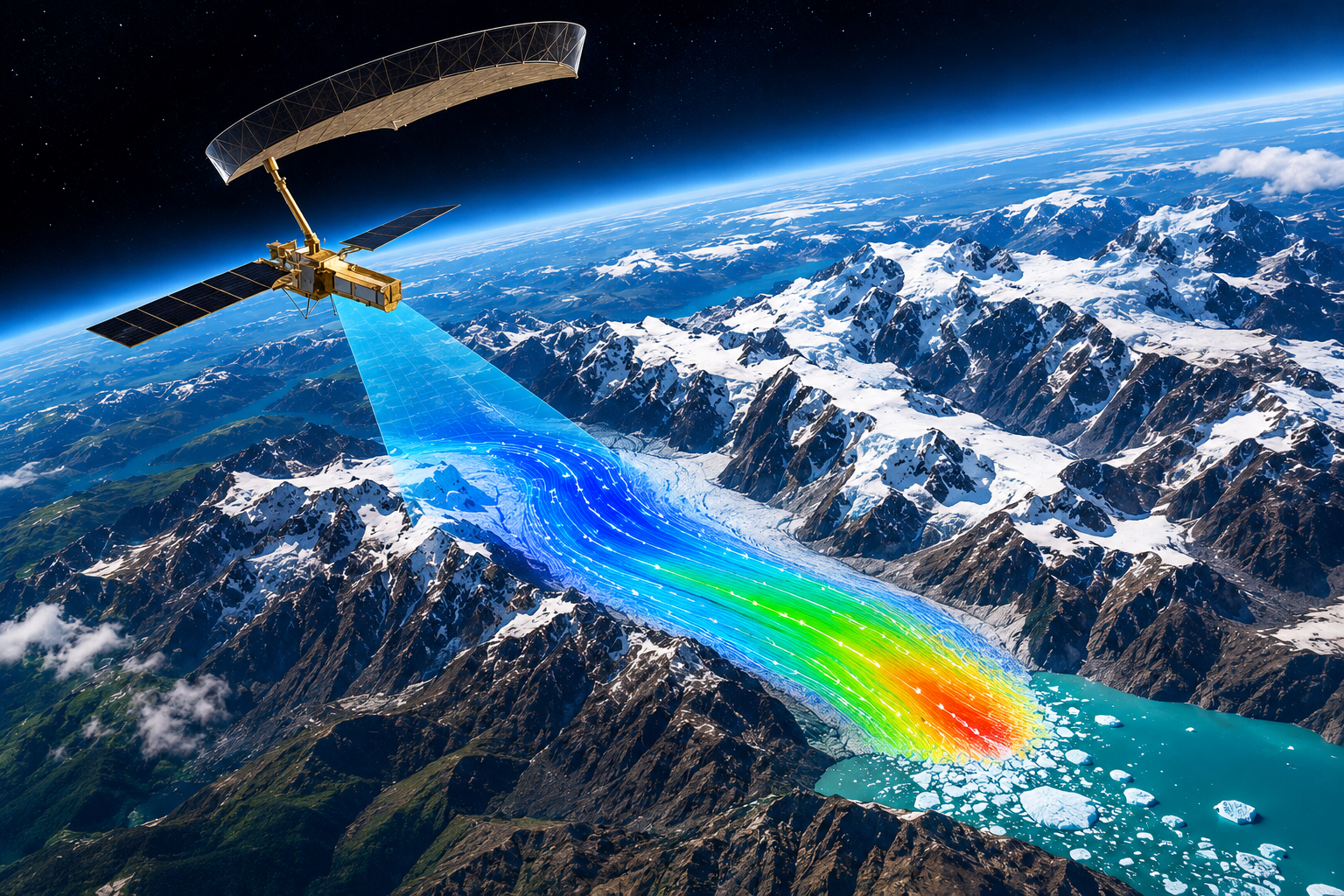
NISAR (NASA-ISRO Synthetic Aperture Radar), a dual-frequency L- and S-band mission developed jointly by NASA and ISRO, entered operation on 30 July 2025 with a 12-day repeat cycle and all-weather, day-night imaging capability. This removes two long-standing constraints on Himalayan glacier monitoring in particular dependence on solar illumination and vulnerability to cloud cover.
This assessment compares NISAR Geocoded offsets (GOFF) products based glacier velocity output against NASA’s ITS_LIVE product, a multi-year, multi-sensor reference datasets. This study is done four glaciers, chosen for contrasting flow dynamics: Samudra Tapu and Bara Shigri, slow-moving valley glaciers in Himachal Pradesh’s Lahaul-Spiti region, and Hubbard and Malaspina, fast-flowing tidewater and piedmont glaciers on the Alaskan coast where daily ice displacement can exceed what the Himalayan sites cover in a month. The four-site design was chosen to test offset-tracking performance across this full speed range. Regardless of absolute velocity, each site’s flow field followed a recognisable pattern: a central high-velocity trunk, elevated flow at tributary junctions, and drag-reduced margins, confirming that the underlying flow structure was well resolved before the numerical comparison began.
At the two Himalayan sites, single-acquisition NISAR estimates required no outlier correction and still landed within a few percent of the ITS_LIVE maximum. Given that ITS_LIVE aggregates years of stacked observations while NISAR here draws on one acquisition pair, this level of agreement is a meaningful early indicator for the slow-to-moderate flow regimes that dominate Himalayan glacier monitoring.
| Glacier | Region | NISAR | ITS_LIVE |
| Samudratapu (Jan 2026) | W. Himalaya | 5.7 – 139.19 m/yr | 0.7 – 132.53 m/yr |
| Bara Shigri (Jan 2026) | W. Himalaya | 1.89 – 68.99 m/yr | 0.47 – 70.58m/yr |
| Hubbard (Oct 2025) | Alaska | 2.42 – 2585.09 m/yr | 0.29 – 3247.55m/yr |
| Malaspina (Oct 2025) | Alaska | 3.4– 1728.31 m/yr | 0.02 – 1690.82m/yr |
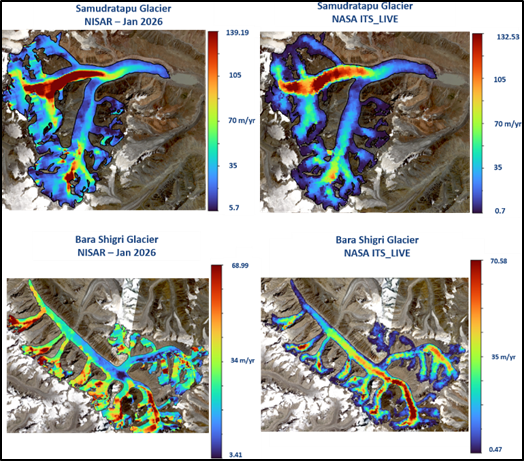
NISAR and ITS_LIVE flow maps for Samudratapu and Bara Shigri Glaciers (both alpine valley type), Western Himalaya.
The Alaskan sites were more demanding. Early velocity estimates show high over estimation, a pattern eventually attributed to the residual speckle in the radar signal rather than to actual flow variability; once that noise was identified and removed, Malaspina’s peak velocity converged with ITS_LIVE to within roughly two percent. Hubbard proved less straightforward — a gap of about twenty percent remained even after the same correction was applied, pointing to a site-specific inconsistency that current data cannot yet explain, rather than a flaw in the masking approach itself. One incidental finding stood out here: NISAR detected a fast-flowing tributary at central location of Hubbard with no counterpart in the ITS_LIVE record, suggesting that multi-year averaging in the reference product may obscure flow detail that a single, higher-resolution pass can capture.
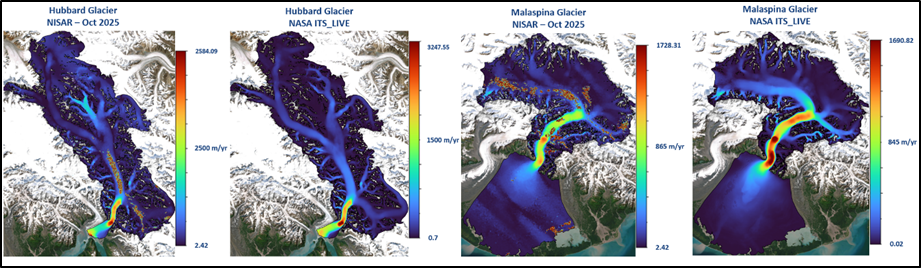
NISAR and ITS_LIVE flow maps for Hubbard (tidewater) and Malaspina (piedmont) glaciers, Alaska.
What held constant across all four sites, fast or slow, was the spatial layout of the flow itself: trunk channels, tributary branches, and slow margins lined up consistently between the two products. That consistency matters more than the numerical gaps, since it points to a sound radar measurement chain even at sites where the statistics still need work, and can be refined as soon as a full year data for the respective site are available.
Taken together, these results place a satellite still in its first year of service on comparable footing, in terms of glacier velocity estimates, with a reference record assembled from a multi-satellite constellation over several years — an outcome that was not guaranteed given how different the two measurement approaches are. The next phase of work will extend the comparison across a full annual cycle at each site, target the Hubbard gap with additional acquisitions, and apply NISAR’s per-pixel correlation SNR layer to narrow the residual noise still present at the Alaskan sites.
Glacier change typically occurs incrementally rather than abruptly, manifesting as centimetre-scale displacement and gradually accumulating strain that is detectable only through sustained, high-frequency observation. Reproduced independently across two Himalayan valley glaciers and two Alaskan tidewater glaciers, and across two seasonally distinct Alaskan acquisitions, within its first year of operation NISAR has demonstrated the capability to reliably detect and characterize this signal.
This work is based on ongoing research under ISRO sponsored NICES project (Multi satellite Multi Sensor Approach to Generate Glacier Related High Resolution Essential Climate Variable Products in Himalaya) at Water Resources Department, IIRS Dehradun
References
Gardner, A. S., Fahnestock, M., Greene, C. A., Kennedy, J. H., Liukis, M., López, L. A., & ***bos, T. (2025). MEaSUREs ITS_LIVE Regional Glacier and Ice Sheet Surface Velocities, Version 2 [Dataset]. NASA National Snow and Ice Data Center DAAC. https://doi.org/10.5067/JQ6337239C96.
Gardner, A. S., Greene, C. A., Kennedy, J. H., Fahnestock, M. A., Liukis, M., López, L. A., Lei, Y., ***bos, T. A., & Dehecq, A. (2025). ITS_LIVE global glacier velocity data in near-real time. The Cryosphere, 19, 3517–3533. https://doi.org/10.5194/tc-19-3517-2025.
National Remote Sensing Centre (NRSC), ISRO (2026). Bhoonidhi — ISRO’s Earth Observation Data Hub: NISAR Data Products Release. Department of Space, Government of India. https://bhoonidhi.nrsc.gov.in/NISAR/
NASA / ISRO (2025). NASA-ISRO SAR (NISAR) Mission — launched 30 July 2025 aboard GSLV-F16 from Satish Dhawan Space Centre, Sriharikota. https://nisar.jpl.nasa.gov.
Strozzi, T., Luckman, A., Murray, T., Wegmüller, U., & Werner, C. L. (2002). Glacier motion estimation using SAR offset-tracking procedures. IEEE Transactions on Geoscience and Remote Sensing, 40(11), 2384–2391. https://doi.org/10.1109/TGRS.2002.805079.
Thakur, P. K., Garg, V., Nikam, B. R., Singh, S., Jasmine, Chouksey, A., Dhote, P. R., Aggarwal, S. P., Chauhan, P., & Kumar, A. S. (2018). Snow cover and glacier dynamics study using C- and L-band SAR datasets in parts of North West Himalaya. International Archives of the Photogrammetry, Remote Sensing and Spatial Information Sciences, XLII-5, 375–382. https://doi.org/10.5194/isprs-archives-XLII-5-375-2018.
No Comments