 Dr. Charu Singh |
June 22, 2026 |
101 Views |
1 Comments
Dr. Charu Singh |
June 22, 2026 |
101 Views |
1 Comments
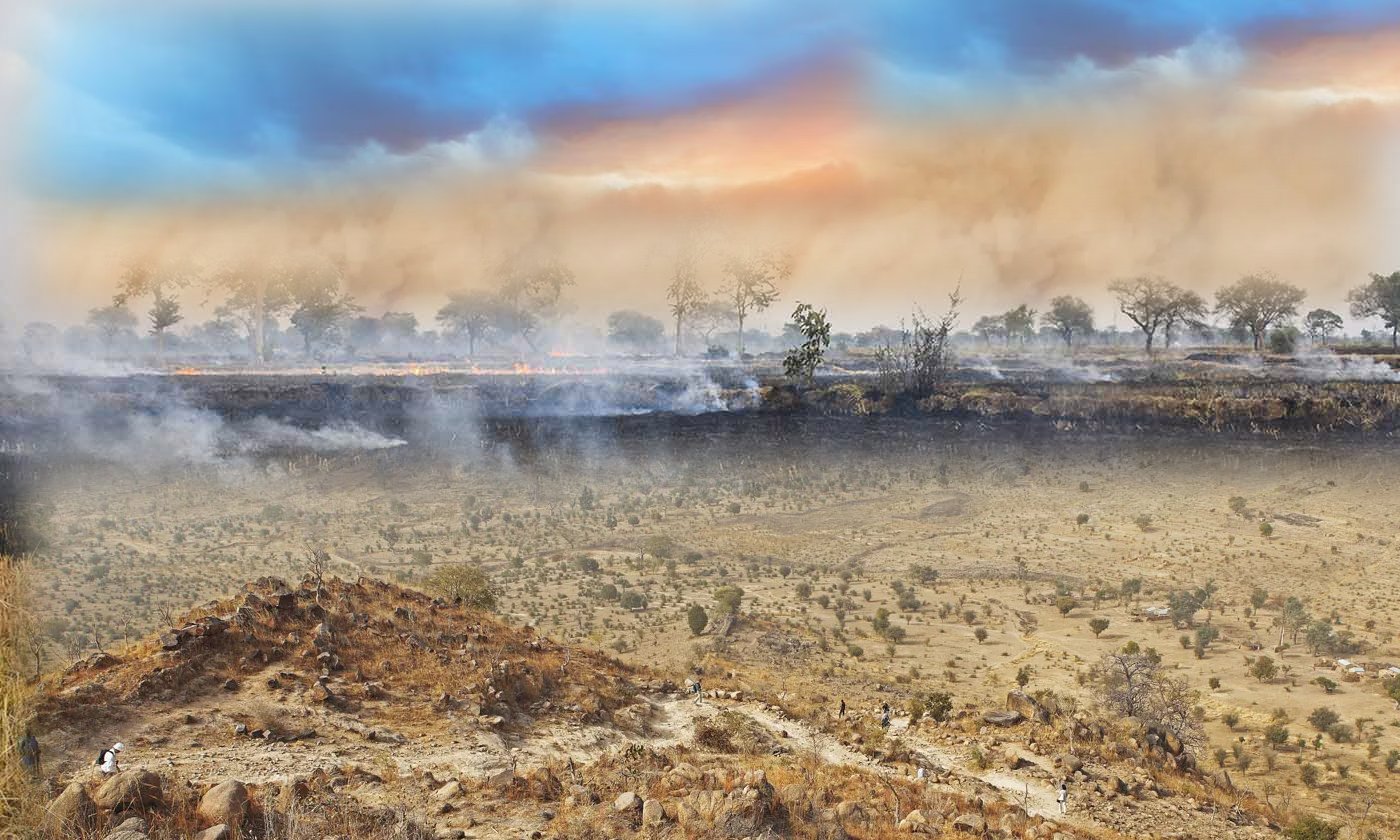
Natural dust emission from an arid or semi-arid region occurs when near-surface wind speed exceeds a threshold wind speed which can further be modulated by several factors such as surface roughness, soil texture, soil moisture, vegetation cover etc. Many major dust sources are located in the subtropical dry belt primarily due to the subtropical high pressure system attributed to the descending branch of Hadley cell that make this region ‘rain deficit’. Apart from this, there are several other factors which are responsible for the existence of deserts over specific location such as distance from the ocean, topography (rain shadow region), cold coastal currents, land use, soil salinity and human disturbance etc. Thar Desert in India is a rain deficit region where monsoon rainfall is very low, predominantly due to its geographical location. On an average, global dust emission is about 1000-2000 Tg/year to which maximum contribution comes from the Sahara desert. Seasonal cycle of dust emission varies regionally and is controlled by regional winds and large scale factors (e.g., Shamal winds, Harmattan winds, monsoon break winds, passage of strong frontal system etc). Mainly, pre-monsoon is the favorable season for the occurrence of extreme dust episodes in the Middle East and South Asia – such as severe dust storms and Haboobs. After the emissions, these dust particles remain suspended in the atmosphere according to their life time or may be carried away to distant regions through long range transport and later deposit over the surfaces (both land and ocean) due to gravitational settling or wet scavenging. At some occasions, trans-pacific transport of dust from Gobi desert is also noted, likewise sometimes dust from Sahara also known to have its destination in the Amazon forest subsequent to severe dust storm activities in the Sahara region.
Dust particles both scatter and absorb shortwave radiation. The net effect on the surface and the atmosphere due to dust depends on its optical properties, size, vertical distribution etc. Dust aerosols are also considered potential CCN and IN and consequently modulate precipitation processes. Role of dust aerosols in modulating Indian Summer Monsoon at different scales is well documented for e.g. dust can modulate monsoon season rainfall patterns and circulation, but this effect varies from region to region depending upon the dust source location. Additionally dust particles play an important role in severe weather activities such as thunderstorms due to its role in convective and microphysical processes as per indirect effect of dust aerosols. Nutrient rich dust particles (such as iron and Phosphorus etc.) are considered important contributors for marine ecosystem as well. Phytoplankton blooms have been observed following dust deposition in previous studies. Nutrient rich dust particles emitted from the Sahara and Gobi deserts are recognised as the important contributor for maintaining rich ecosystem of Amazon forest in South America and Sierra Nevada in California, North America respectively. Dust particles can severely degrade the air quality and visibility of those regions which are either hit by dust storms or by transported dust. Fine size dust particles contribute to particulate matter concentration (PM2.5), and depending upon the chemical composition (deciding factor for toxicity), it may result in cardiovascular and respiratory morbidity and mortality for e.g. lung disease. Low visibility subsequent to the enhanced dust particles in the atmosphere limits functionality of aviation sector, renewable energy (solar panels) etc. Enhanced dust content in the atmosphere may disrupt atmospheric chemistry (photochemical processes) and bring down tropospheric ozone formation. Furthermore, dust can also contribute to accelerate glacier melting and reduction in snow cover by reducing surface albedo. Certainly, dust is one of the important contributor in modulating various climatic, atmospheric, environmental and ocean bio-geochemistry processes.
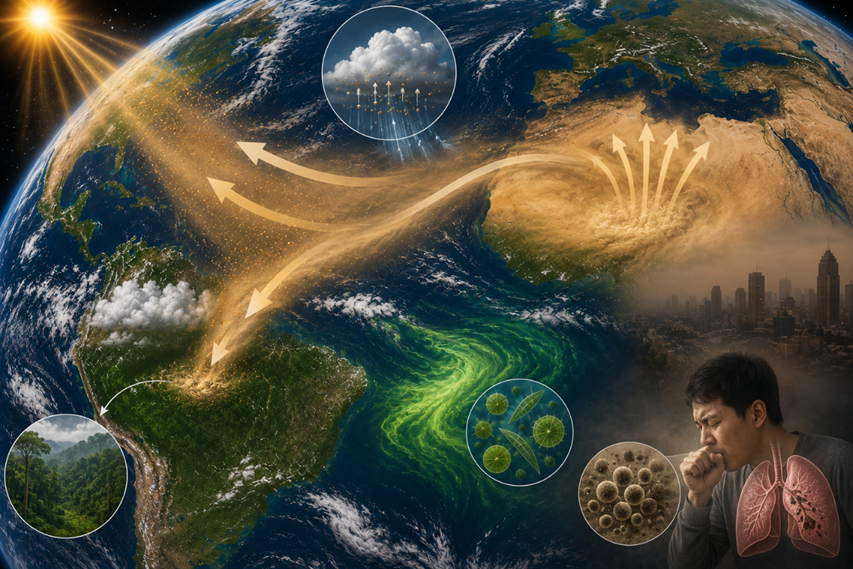
Figure 1: Illustration for depicting the role of natural dust on various climatic, atmospheric, environmental and ocean bio-geochemistry processes.
** (For detailed information readers may refer to scientific literature, below mentioned published articles and references therein)
Bibliography :
- Albrecht, B. A., 1989. Aerosols, cloud microphysics, and fractional cloudiness, Science, 245(4923), 1227- 1230.
- Budakoti S., Singh C. and Choudhury A., 2023. Transport of a severe dust storm from Middle East to Indian region and its impact on surrounding environment. International Journal of Environmental Science and Technology, 20, 10345-1036. https://doi.org/10.1007/s13762-022-04520.
- Dey, S. et al., 2004. Influence of dust storms on the aerosol optical properties over the Indo-Gangetic basin. Journal of Geophysical Research, VOL. 109, D20211, doi:10.1029/2004JD004924 .
- Ginoux, P. et al., 2012. Global-scale attribution of anthropogenic and natural dust sources and their emission rates based on
- MODIS Deep Blue aerosol products, Rev. Geophys., 50, RG3005, doi:10.1029/2012RG000388.
- Grandey, B. S., et al. 2014., Rainfall-aerosol relationships explained by wet scavenging and humidity, Geophys. Res. Lett., 41, 5678–5684, doi:10.1002/2014GL060958.
- Ramanathan, V. et al., 2005. Atmospheric brown clouds: Impacts on South Asian climate and hydrological cycle, Proceedings of the National Academy of Sciences of the United States of America, 102 (15), 5326 5333, doi:10.1073/pnas.0500656102.
- Singh C. et al., 2019a. Impact of West Asia, Tibetan Plateau and local dust emissions on intra-seasonal oscillations of the South Asian monsoon rainfall. Climate Dynamics https://doi.org/10.1007/s00382-019-04944-5.
- Singh C. et al., 2019b. Climate response of the south Asian monsoon system to West Asia, Tibetan Plateau and local dust emissions. Climate Dynamics. https://doi.org/10.1007/s00382-019-4925-8 .
- Singh C. et al., 2021. Simulation of an extreme dust episode using WRF-CHEM based on optimal ensemble approach. Atmospheric Research, Volume 249, 105296. https://doi.org/10.1016/j.atmosres.2020.105296
Vinoj, V. et al., 2014. Short-term modulation of Indian summer monsoon rainfall by West Asian dust. Nature Geoscience 7, 308–313. https://doi.org/10.1038/ngeo2107
Sachin
July 23, 2026Dr. Singh, I really enjoyed reading this article. It’s a remarkably detailed, insightful, and thought-provoking analysis of how natural dust influences our environment, weather, climate, and ecosystems. I especially appreciated how you connected atmospheric physics with broader environmental and biogeochemical processes. I have one question out of curiosity. When you mention that dust emission begins once the near-surface wind speed exceeds a threshold, is Bernoulli’s theorem also involved in the initial lifting of the particles? My understanding is that as wind speed increases over the surface, the pressure above a dust particle decreases relative to the pressure beneath it, creating a lifting force that helps detach the particle. Or is the process explained more by aerodynamic drag, shear stress, and turbulent eddies than by Bernoulli’s principle? I’d love to hear your perspective on the underlying physics.