 Manu Mehta |
June 1, 2026 |
165 Views |
1 Comments
|
Manu Mehta |
June 1, 2026 |
165 Views |
1 Comments
| 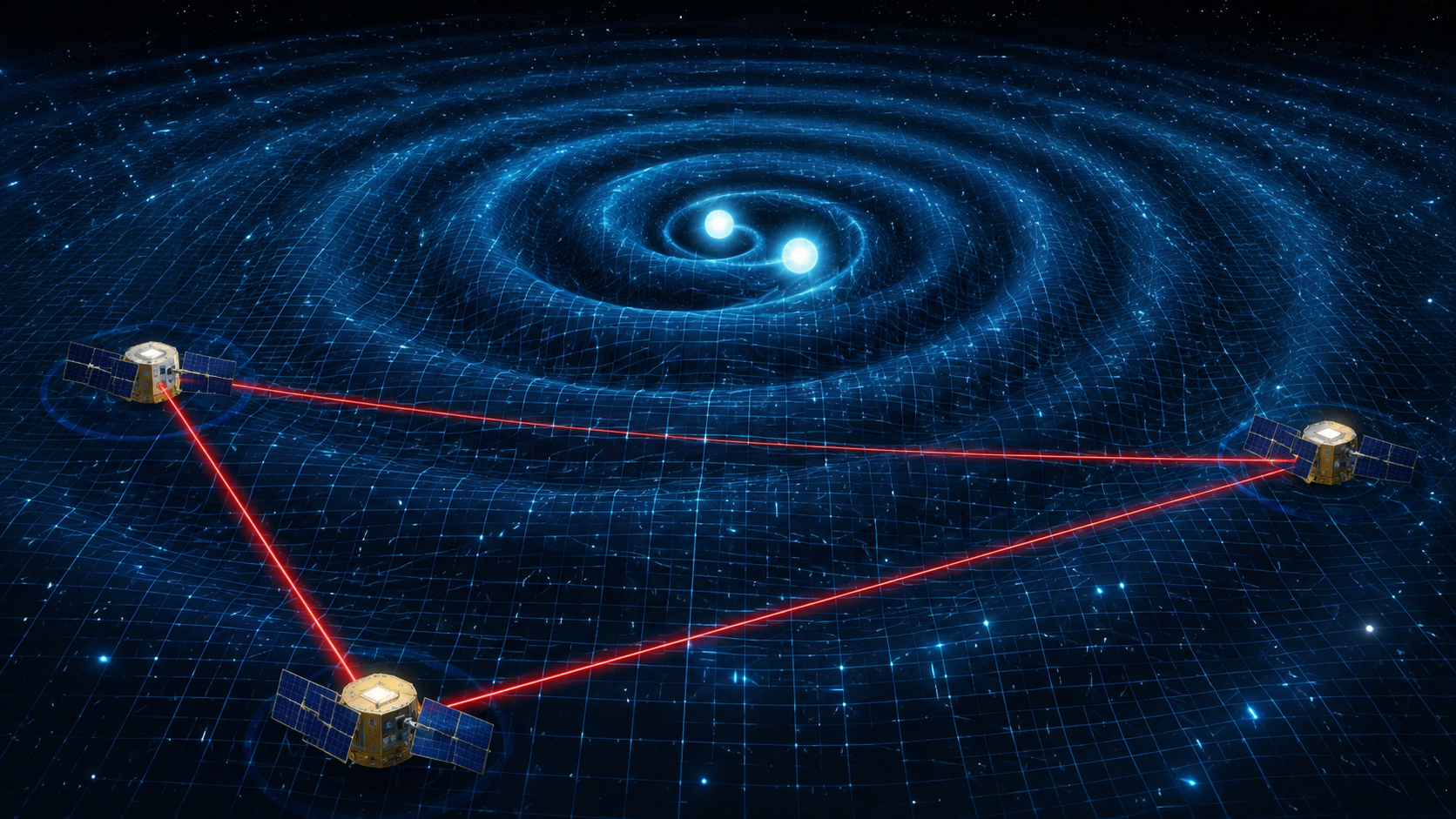
Gravitational waves are tiny ripples in spacetime produced when massive objects accelerate, especially during some of the most energetic events in the universe. But what does it truly mean for spacetime itself to “ripple”? How can something so abstract produce measurable physical effects? The concept originates from Albert Einstein’s general theory of relativity (1916), which describes gravity not as a conventional force but as curvature in spacetime produced by mass and energy. Instead of thinking of gravity as an invisible pull, spacetime can be understood as a dynamic geometric structure that responds to mass and energy. What happens when massive objects dynamically disturb this geometry? The answer is gravitational waves: propagating distortions that travel at the speed of light (Einstein, 1916; Einstein, 1918). In physical terms, gravitational waves are generated by asymmetric acceleration of mass, particularly from systems with changing quadrupole moments. The strongest gravitational waves are produced by compact binary systems such as merging black holes and neutron stars, where enormous masses orbit each other at relativistic speeds in extremely strong gravitational fields (Maggiore, 2008; Miller & Yunes, 2019). These systems emit waves that produce oscillatory stretching and compression of spacetime transverse to their direction of propagation. Yet if such a wave passes through Earth, would we notice it? In practice, no, the strain is extraordinarily small, meaning changes in length are smaller than a fraction of a proton over kilometers.
Although Einstein predicted these waves, the physical interpretation and energy-carrying nature of gravitational waves were debated for decades. Early theoretical developments clarified that gravitational waves carry energy and angular momentum away from systems (Bondi, 1957). A crucial indirect confirmation came from the Hulse-Taylor binary pulsar, where orbital decay matched predictions from gravitational radiation theory (Hulse & Taylor, 1975; Taylor & Weisberg, 1982). Direct detection, however, required extreme experimental precision. Early attempts such as Weber’s resonant bar detectors in the 1960s were pioneering, but not confirmed (Weber, 1960). The breakthrough came with laser interferometry, capable of detecting minuscule changes in distance by measuring differential phase shifts caused by tiny changes in arm length. This led to the development of the Laser Interferometer Gravitational-Wave Observatory (LIGO). On September 14, 2015, the LIGO Scientific Collaboration reported the first direct detection of gravitational waves from a binary black hole merger (GW150914), confirming a major prediction of general relativity (Abbott et al., 2016a). The signal, a distinctive ‘chirp’ where frequency and amplitude increase as the binary components spiral inward and merge, matched numerical relativity models with extraordinary precision and marked the beginning of gravitational wave astronomy. Shortly after, the Virgo detector joined the network, improving sky localization of events (Acernese et al., 2015). In 2017, GW170817 marked a breakthrough: a binary neutron star merger was observed both in gravitational waves and across the electromagnetic spectrum. This confirmed multi-messenger astronomy and showed that such mergers are key sites for the formation of heavy elements like gold and platinum (Abbott et al., 2017a; Abbott et al., 2017b). This event also helped constrain the speed of gravitational waves to be extremely close to the speed of light (Abbott et al., 2017c).
Modern gravitational wave research combines observational data with numerical relativity, which solves Einstein’s field equations for strong-field, highly dynamical systems such as merging compact objects. These simulations are essential for extracting physical properties such as mass, spin, and distance from observed waveforms (Pretorius, 2005; Blanchet, 2014). Machine learning and deep-learning techniques are increasingly being explored for signal classification, denoising, and rapid event identification (George & Huerta, 2018). At the observational level, ground-based detectors such as LIGO, Virgo, and KAGRA continue to improve in sensitivity (KAGRA Collaboration, 2020), while future facilities like the Einstein Telescope and Cosmic Explorer aim to extend detection capabilities for compact-object mergers (Punturo et al., 2010; Reitze et al., 2019). In parallel, space-based missions such as the Laser Interferometer Space Antenna (LISA), DECIGO, and TianQin are designed to explore lower-frequency gravitational waves from supermassive black hole mergers, galactic binaries, and possibly even primordial signals originating from processes in the early universe shortly after the Big Bang (Amaro-Seoane et al., 2017; Kawamura et al., 2011; Luo et al., 2016). Meanwhile, Pulsar Timing Arrays (PTAs) use extremely stable neutron stars as cosmic clocks to search for ultra-long-wavelength gravitational waves generated by galaxy-scale black hole mergers. Recent observations from PTAs are providing growing evidence for a stochastic gravitational wave background likely produced by populations of supermassive black hole binaries (Agazie et al., 2023).
Gravitational wave astronomy is still in its early stages, yet it has already transformed our understanding of the universe. Unlike traditional telescopes that observe light, gravitational wave detectors allow us to study cosmic events through distortions in spacetime itself. Together, current and future observatories across ground-based, space-based, and pulsar-timing platforms are transforming gravitational wave science from a remarkable experimental achievement into a major branch of observational astronomy, offering new ways to probe black holes, neutron stars, galaxy evolution, and the fundamental nature of spacetime itself.
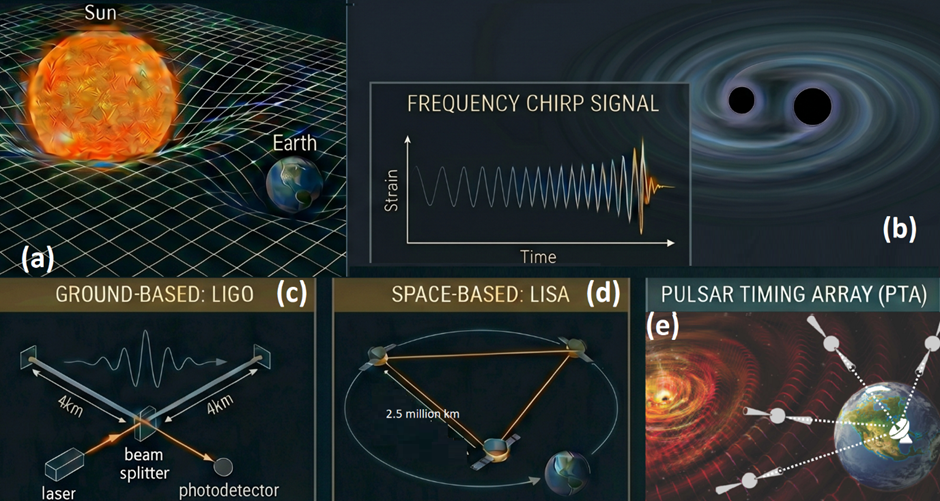
Figure 1 Educational illustrations showing (a) spacetime curvature around massive objects, (b) an example of gravitational wave source and signal, and major gravitational-wave detection techniques including (c) ground-based interferometry (LIGO; not to scale), (d) space-based interferometry (LISA), and (e) Pulsar Timing Arrays (PTAs; PTA concept adapted from Space Australia, 2023).
References
Abbott, B. P., et al. (2016a). Observation of gravitational waves from a binary black hole merger. Physical Review Letters, 116(6), 061102. https://doi.org/10.1103/PhysRevLett.116.061102
Abbott, B. P., et al. (2017a). GW170817: Observation of gravitational waves from a binary neutron star inspiral. Physical Review Letters, 119(16), 161101. https://doi.org/10.1103/PhysRevLett.119.161101
Abbott, B. P., et al. (2017b). Multi-messenger observations of a binary neutron star merger. The Astrophysical Journal Letters, 848(2), L12. https://doi.org/10.3847/2041-8213/aa91c9
Abbott, B. P., et al. (2017c). GW170817: Gravitational waves and gamma-rays from a binary neutron star merger. The Astrophysical Journal Letters, 848(2), L13. https://doi.org/10.3847/2041-8213/aa920c
Acernese, F., et al. (2015). Advanced Virgo: A second-generation interferometric gravitational wave detector. Classical and Quantum Gravity, 32(2), 024001.
Agazie, G., et al. (2023). Evidence for a gravitational-wave background in the NANOGrav 15-year data set. The Astrophysical Journal Letters, 951(1), L8. https://doi.org/10.3847/2041-8213/acdac6
Amaro-Seoane, P., et al. (2017). Laser Interferometer Space Antenna. arXiv:1702.00786.
Blanchet, L. (2014). Gravitational radiation from post-Newtonian sources and inspiralling compact binaries. Living Reviews in Relativity, 17, 2.
Bondi, H. (1957). Plane gravitational waves in general relativity. Nature, 179, 1072–1073.
Einstein, A. (1916). Näherungsweise Integration der Feldgleichungen der Gravitation. Sitzungsberichte der Königlich Preußischen Akademie der Wissenschaften.
Einstein, A. (1918). Über Gravitationswellen. Sitzungsberichte der Königlich Preußischen Akademie der Wissenschaften.
George, D., & Huerta, E. A. (2018). Deep learning for real-time gravitational wave detection and parameter estimation. Physics Letters B, 778, 64–70. https://doi.org/10.1016/j.physletb.2017.12.053
Hulse, R. A., & Taylor, J. H. (1975). Discovery of a pulsar in a binary system. The Astrophysical Journal, 195, L51–L53.
KAGRA Collaboration. (2020). KAGRA: 2.5 Generation Interferometric Gravitational Wave Detector. Nature Astronomy, 4, 1–8.
Kawamura, S., et al. (2011). The Japanese space gravitational wave antenna: DECIGO. Classical and Quantum Gravity, 28(9), 094011.
Luo, J., et al. (2016). TianQin: A space-borne gravitational wave detector. Classical and Quantum Gravity, 33(3), 035010.
Maggiore, M. (2008). Gravitational Waves: Volume 1: Theory and Experiments. Oxford University Press.
Miller, M. C., & Yunes, N. (2019). The new frontier of gravitational waves. Nature, 568, 469–476. https://doi.org/10.1038/s41586-019-1129-z
Pretorius, F. (2005). Evolution of binary black-hole spacetimes. Physical Review Letters, 95(12), 121101.
Punturo, M., et al. (2010). The Einstein Telescope: A third-generation gravitational wave observatory. Classical and Quantum Gravity, 27(19), 194002.
Reitze, D., et al. (2019). Cosmic Explorer: The U.S. contribution to gravitational-wave astronomy beyond LIGO. Bulletin of the AAS, 51(7), 035.
Space Australia. (2023). Humanity’s galactic-scale detectors: Pulsar timing arrays. https://spaceaustralia.com/feature/humanitys-galactic-scale-detectors-pulsar-timing-arrays
Taylor, J. H., & Weisberg, J. M. (1982). A new test of general relativity. The Astrophysical Journal, 253, 908–920.
Weber, J. (1960). Detection and generation of gravitational waves. Physical Review, 117(1), 306–313.
Dr Nimba Ram
June 1, 2026This paper is informative and will provide a new direction in the field of science, offering a knowledge for researchers and educational endeavors.