 Pratima Pandey |
May 25, 2026 |
161 Views |
1 Comments
|
Pratima Pandey |
May 25, 2026 |
161 Views |
1 Comments
| 
Rock glaciers in cold-arid part of northwestern Himalaya appear to be more directly and extensively a part of human settlement and land use than glaciers and have a greater and more immediate impact on livelihood. In the cold semi-arid part of Himalaya, most of the civilization has developed in the peri and paraglacial environment and thus permafrost and rock glaciers (intact and relict) are very much part of their lives influencing both directly and indirectly. Both ecosystems and livelihood are strongly dependent to varying degree on the thaw water from rock glaciers and permafrost in addition to seasonal snowmelt since glaciers are located at very high altitude in such regions and the river flows are out of reach. People in the high mountain Himalaya have established a more harmonic relationship with glaciers and nature. Glacier marriage, Glacier grafting and Ice Stupa are some of the examples of the pristine human-nature interactions and the respect of the local for nature and ecosystem. The beautiful example of this sustained human-nature interaction at high mountain Himalaya is the inhabitation on relict rock glaciers. In the cold semi-arid region of this part of Himalaya where water availability is abundant but the accessibility is challenging, local people have found the relict rock glaciers as their suitable home with water available from the thawing of palaeo-permafrost in these landforms. In Leh (Ladakh), Budhkharbu and in Spiti (Lahaual and Spiti, Himachal) Komic, Chicham and Hikkim are example of relict rock glaciers harboring livelihood. These relict rock glaciers are located in the lower limit of discontinuous and sporadic permafrost zones. The seasonal snowmelt and the thawed water at the upper reaches of these landforms due to climate warming have suitably established a local ground water system and provide perennial water to the community living on them. Thus, these decayed rock glaciers despite their decaying state is sustaining lives on them. However, their sustainability is in question owing to the irreversible climate change (warming and shifting) in the region. We believe there are more such relict rock glacier exist sustaining civilization by decaying itself. It is the high time to explore the potential of such rock glaciers and finding a way forward to sustain them.
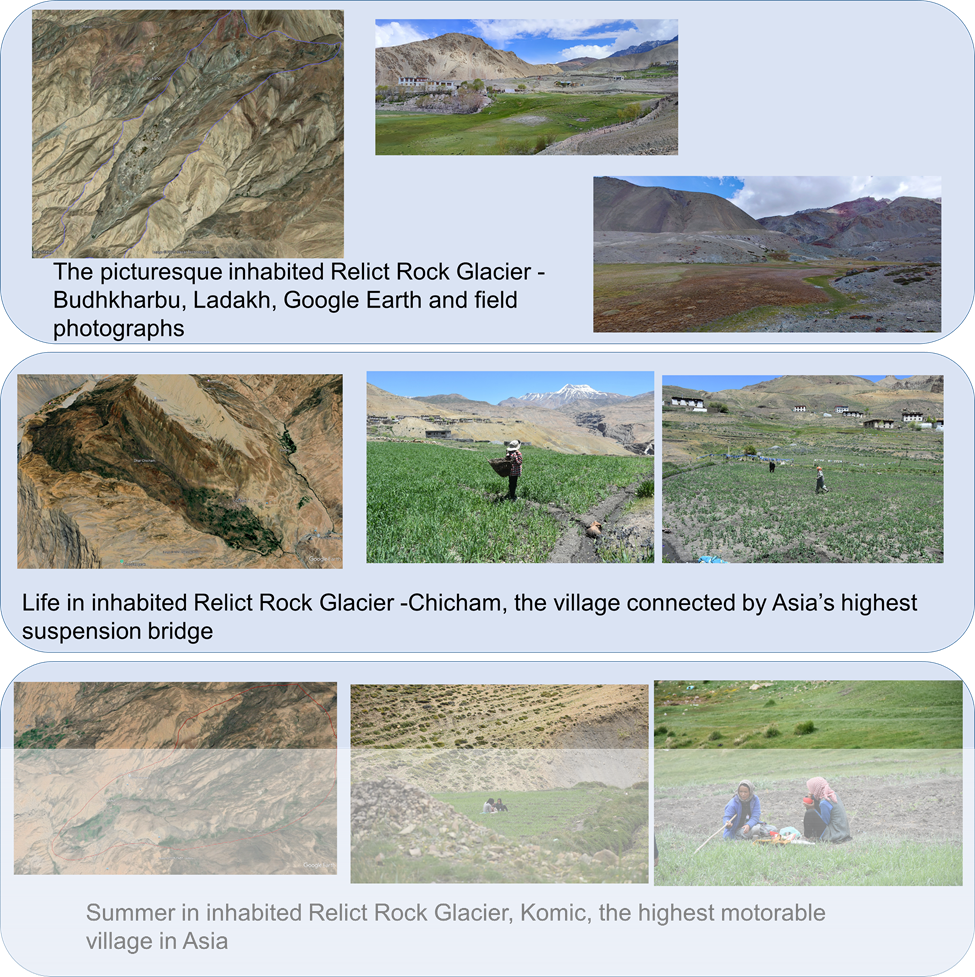
Figure-1: The different inhabited relict rock glaciers in semi-arid part of western Himalaya, India.
References:
Pandey, P., S. N. Ali, and S. Allen 2022. Rock Glacier Oasis: An Alternative for Agro-Pastoralism in a Changing Environment in the Himalayan Cold Desert. The Geographical Journal 188 (4): 585–590. https://doi.org/10.1111/geoj.12468 .
Shaheen, F.A. 2016. The art of glacier grafting: Innovative water harvesting techniques in Ladakh. IWMI-Tata Water Policy Research Highlight 8. 8p.
https://www.iwmi.org/blogs/grafting-glaciers-and-building-ice-stupas
Cite This Article
| Pratima Pandey Pratima Pandey, 2026. Inhabitation on rock glaciers in Himalaya: nature, humanity and sustainability, SUDOOR MANTHAN- IIRS Science Portal, May 25, 2026, URL- https://science.iirs.gov.in/inhabitation-on-rock-glaciers-in-himalaya-nature-humanity-and-sustainability/ |
Neha
October 3, 2026“I would like to know about the available scholarship opportunities for undergraduate students. Please provide information regarding eligibility criteria, application process, required documents, and the last date to apply.”