 Jappji Mehar |
April 10, 2026 |
130 Views |
0 Comments
|
Jappji Mehar |
April 10, 2026 |
130 Views |
0 Comments
| 
The Science in Sci-Fi
The realm of Sci-Fi transgresses to real science in Andy Weir’s book and its film adaptation “Project hail Mary”. This article explores the various concepts introduced in the movie from an educational perspective.
The story begins with the protagonist waking up in a spaceship with no recollection of anything whatsoever. As he tries to make sense of his surroundings, amidst the personal discovery that he is ‘smart’; he discovers he is in space and very, very, very far away from home. The movie draws the audience in with relevant flashbacks and we learn that the person is a Dr. Ryland Grace aboard Hail Mary spacecraft.
An astronomer, Petrova has discovered a line only observable in the IR part of the EM spectrum, spanning the distance from Sol to Venus (hence called Petrova line). Sol, our sun and several other stars in the neighbourhood are soon observed to be dimming. At this rate, the Earth’s temperature could go down by 10-15°C in the next 30 years. During the last Glacial Maximum which saw massive ice sheets spread across North America and Eurasia around 20,000 years ago; global temperatures were likely about 5°C colder than today. So it is a big Whoop.
As probe results splash down, Grace is approached by an agent with the Petrova Task Force to ask if he stands by what he wrote in his doctrate (Molecular Biology) thesis “Water is not necessary for life to thrive”. One thing leads to another and Grace finds himself analysing the sample, in what he calls first contact. The “Astrophage”(Greek for Star-Eater) is impervious to all wavelengths of EMR appearing as black dots moving across the slide. He accidently kills one sample in trying to insert probably an integrated nanwire probe. Lo and behold! In its death, the black dot became transluscent allowing for the discovery that astrophage has a cell structure similar to eukaryotic cells (similar to plant and animal cells having a cell membrane, cytoplasm, organelles etc.) on Earth. Surviving on the surface of Sol, the miroscopic life form did not appear to be water-based. Its elemental composition results however (probably using non-destructive Raman spectroscopy or NanoSIMS) reveal Astrophage to be made primarily of Hydrogen (H), Oxygen (O) and Carbon (C).
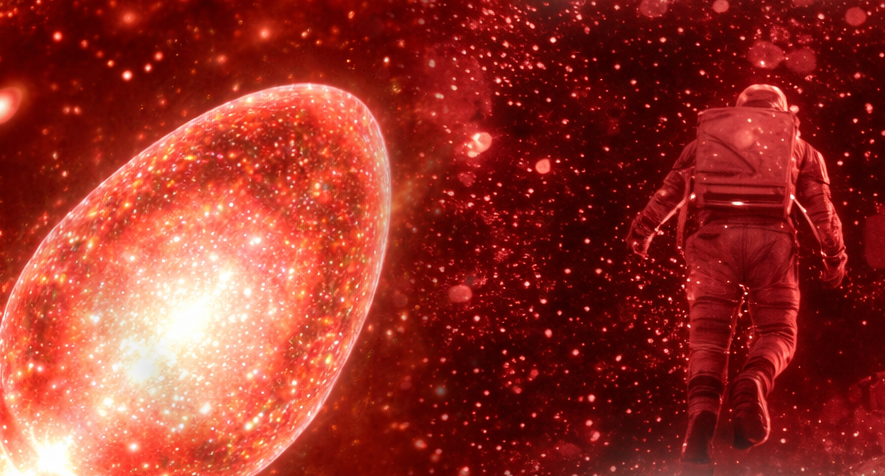
Astrophage is where the Second Law of Thermodynamics and the laws of Quantum Physics are broken but the story essentially builds consistently from the ground up hereon. To eleborate; astrophage has super cross-sectionality and is extremely efficient at converting mass to energy, which means it can absorb all wavelenghts of EMR, even those which are greater than its diameter (around 10 micrometer) thereby acting as a radiation shield in space. In other words, astrophage is opaque to all wavengths of radiation and even neutrinos (subatomic chargeless particles of very small mass). Nothing can Quantum Tunnel (Particles overcoming a higher energy barrier and having a finite non zero probability of occuring across) through it. Its cell membrane is made up of protons which collide to produce neutrinos and dissipate excess energy thereby maintaining a constant internal temperature of 96.415 deg C, astrophage’s critical temperature. This is why even though its made of water, the cell can survive on the surface of stars. The book mentions that it can store upto 1.5 MJ of energy (following E=mc2) which it can release to power its metabolism, heat itself if it drops below the critical temperature and propel itself. It emits radiation at the Petrova-wavelength to propel itself at immense velocities and accelerations, reaching up to 92% of the speed of light.
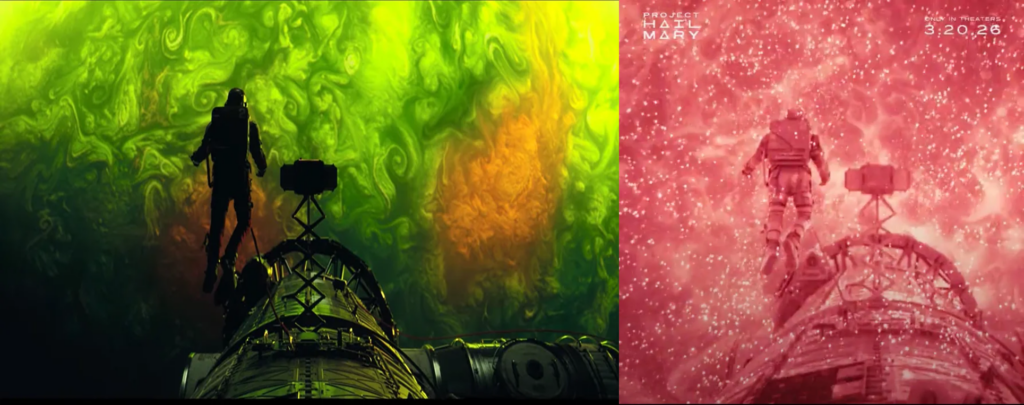
‘Adrian’ and Grace in visible (left) and IR (right)
The importance of step-by-step questioning is highlighted when Grace questions the astrophage migration to Venus. In an experiment he switches on a source that has the same spectral signature as CO2. Possibly a container of CO2 gas is excited using a light source. If the spectrqa of such is taken it will have lanks where the CO2 will have absorbed radiation in wavelengths characteristic to itself. The electrons in the outermost ***s get excited to higher energy levels and when the de-excite via collisions or otherwise, they emit radiation in wavelengths characteristic to CO2, i.e. the spectral signature of CO2. Just as the source is switched on, the particles fly off the silde. Creating a darkroom and using IR to locate the precious samples, Grace comes across a fourth. Completely unaware of the implications for such a discovery, he is informed that a large scale project to multiply astrophage is in fact the need of the hour.
‘Adrian’ and Grace in visible (left) and IR (right)
The astrophage use the C in CO2 (carbon-based life form) to reproduce and hence are attacted to the unique spectral signature of CO2 occuring at 96.5% of the dense Venus atmosphere. The book mentions that multiple stars within 8 ly of Sol have fallen prey to Astrophage so it is a cosmic level problem. They also mention that it can travel 8 ly in spore form without dying so considering that multiple stars have at least one more star within 8 ly of itself, the infection would be pretty widespread. They however do assume that at least one planet orbiting the star has an atmosphere rich in CO2 which is information that seems too far fetched since it is only recently that an exoplanet’s atmosphere was ascertained to have CO2 using the James Webb Telescope.
Tau Ceti, a single main sequence (undergoing stable nuclear fusion of Hydrogen to Helium in its core) G-type star (spectral type denoting the surface temperature and absorption spectra, ranging from O, B, A, F, G, K to M) is 11.9 ly from Sol had 4 exoplanets orbiting it according to a 2017 study one of which was the movie’s Tau Ceti E. Christened ‘Adrian’ after Rocky’s mate it was home to Taumoeba, a predatory species which bred in its CO2 rich clouds, kept Astrophage population in check and prevent Tau Ceti from dimming. Tau Ceti was the only star with a Petrova line and no change in luminosity which is why the Petrova Task Force decided to send ‘Hail Mary’ to Tau Ceti to ‘Save Humanity’ as a last resort. Time dilation at relativistic speeds cause time on earth to pass faster than time on Hail Mary with respect to an observer on the spaceship. Hence during the journey that took around 4 years to Tau Ceti using astophage as fuel, about 13 years have passed on the earth.
40 Eridani A is a main sequence K-type star, part of a three star system with 40 Eridani B and C. All three are part of constellation Eridanus. 40 Eridani A is 16.3 ly away from Sol. The first exoplanet orbiting it is the movie’s ‘Erid’, home to an Eridian – ‘Rocky’.
That both the stars have been recently studied and the exoplanet rings around them declared to be artefacts of data analysis is another fact.
The idea of ‘panspermia’ that life may have been seeded through the cosmos after arising in a particular location is used in the book. Life is said to have evolved on Adrian. Single celled ancestors of Astrophage developed a method to hop, skip and jump from star to star. This apears to be deliberate as Tau Ceti is thought to be upwards of 9 billion years old ~ twice the age of Sol.
Lastly, the movie and book both explore the idea that humans first interact with an alien species less advanced than them in some respects, especially discovery of relativity (Eridians had stored more fuel than required for the journey), radiation shields (Rocky’s entire crew was killed by radiation sickness). The Eridians of Erid however used advanced echolocation (similar to what bats use) to ‘see’, are better at materials science and and computationally advanced.
Disclaimer: In an alternate reality it may be possible that stars are ‘eaten’ by cosmic mold powerful enough to fuel interstellar travel. That it is not so in the universe as we know it is hardly any reason we do not enjoy the story.
No Comments